In short: how can you improve customer contact rates?
Check your contact data and permissions. Make your company easy to identify. Respond promptly to inbound requests. Use the customer's preferred channel and explain why you are getting in touch. Start with a relevant message when appropriate, give people the option to send a voice note, and make the call when there is a good reason to speak live. Measure the people you actually reach and the outcomes you achieve—not the number of times you dial.
Seven actions to prioritize:
- Verify phone numbers, customer records and permission to contact.
- Protect your caller ID and phone number reputation.
- Follow up quickly without calling repeatedly.
- Choose channels by market, relationship and preference.
- Send a first message that gives people context.
- Offer voice notes when talking is easier than typing.
- Call when the customer is ready or live help is needed.
Picture a familiar situation. Someone requests a quote. Ten minutes later, their phone rings. They're in a meeting and don't recognize the number, so they let it ring. A sales agent tries again that afternoon, with the same result. The prospect was interested. The timing and the channel simply didn't work.
This happens in sales, customer service and collections. An unanswered call is not always a rejected conversation.
Why are customers answering fewer unknown calls?
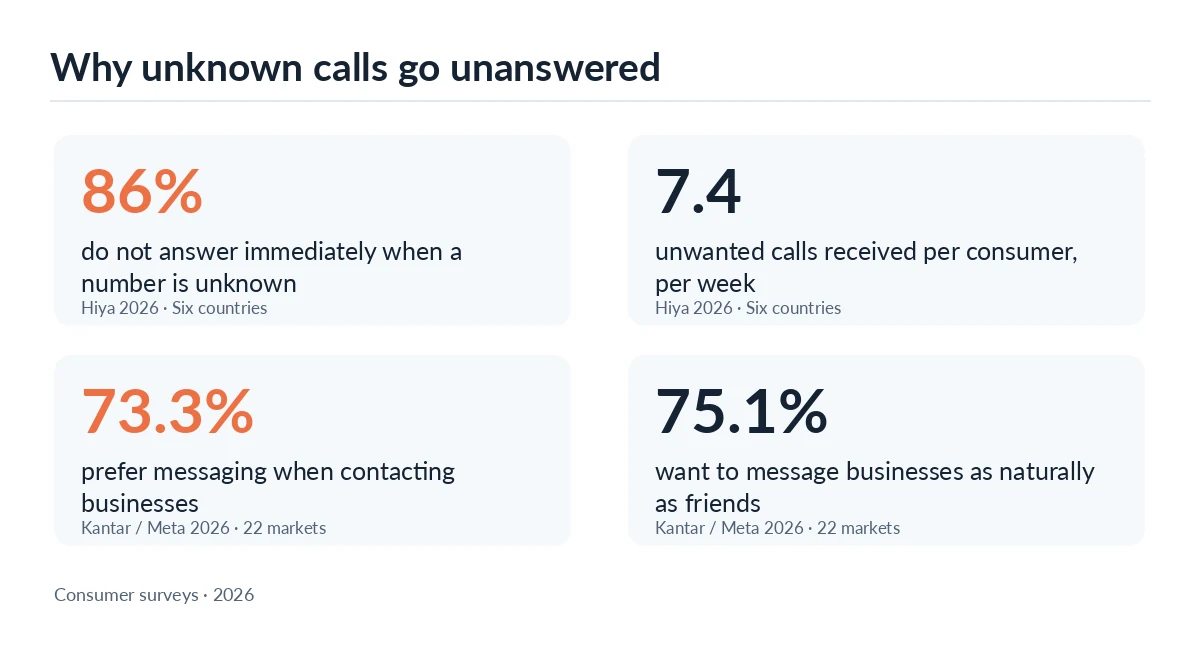
Trust is a large part of the problem. Hiya's State of the Call 2026, a survey of more than 12,000 consumers in six countries, found that only 14% answer immediately when a number is unfamiliar. That leaves 86% who do not answer straight away. It is a finding about consumer behavior, not a measured failure rate for every outbound campaign. The same research reports an average of 7.4 unwanted calls per person per week (Hiya, March 2026).
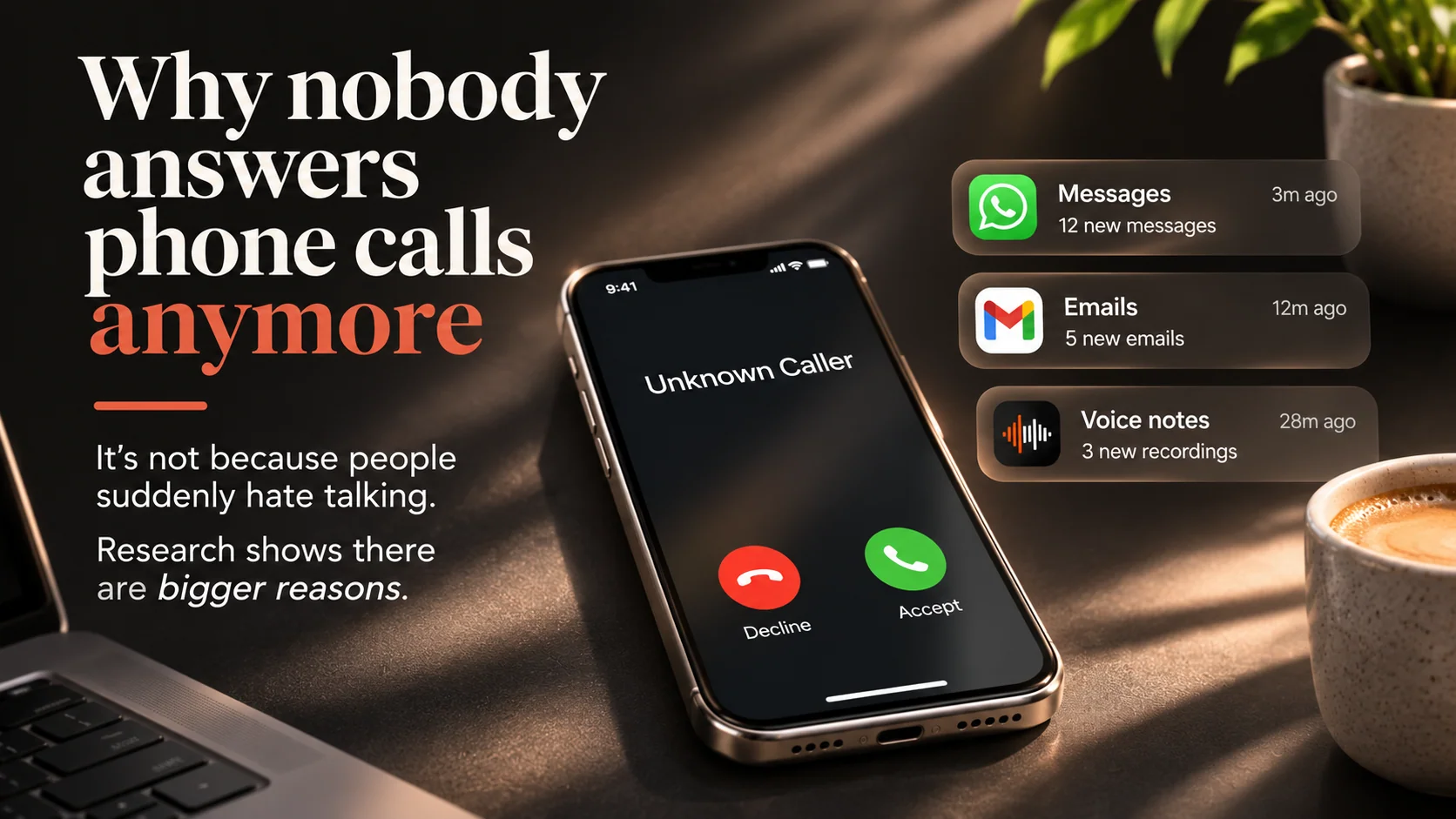
What this infographic shows
A smartphone shows an incoming call from an unknown number. Beside it are messaging, email and voice-note notifications. The illustration introduces the idea that people may avoid unknown phone calls while remaining willing to communicate on other channels.
Messaging feels different. In Kantar research commissioned by Meta, involving 11,056 adults across 22 markets, 73.3% said they prefer messaging when communicating with businesses, while 75.1% wanted to message a business in much the same way they message friends and family. The survey was conducted in 2025 and published in 2026.
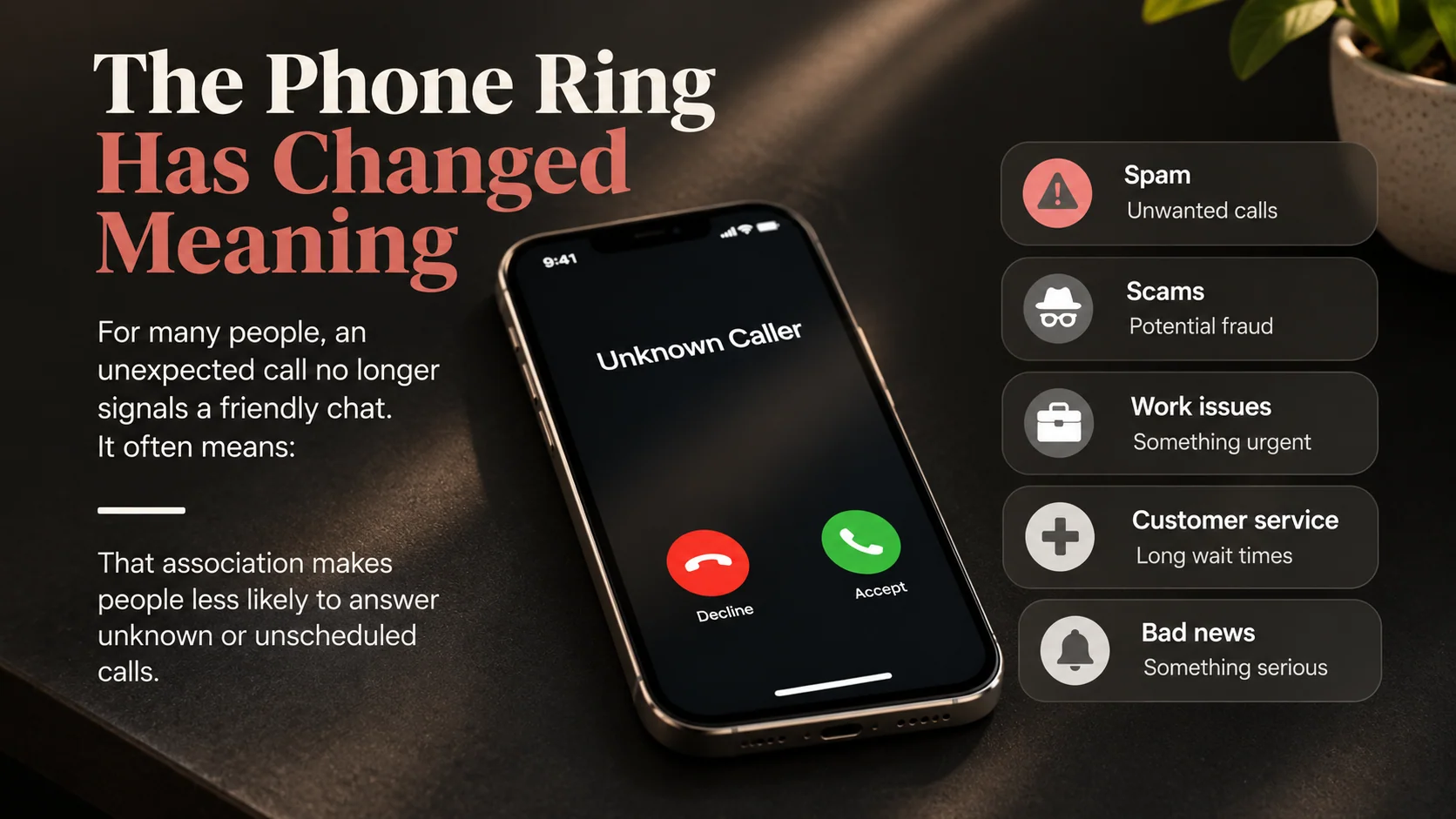
What this infographic shows
An unknown caller appears alongside possible associations such as spam, scams, work problems, customer-service delays and bad news. The illustration depicts why unexpected calls may trigger caution.
Why the reluctance? Spam and fraud have made unknown numbers harder to trust. And a phone call requires attention right now, without always giving the recipient a reason to answer. A message can explain who is contacting them and let them respond on their own terms.
The phone call hasn't lost its value. An unexpected call with no context has lost some of its welcome.
Contact rate vs. call answer rate: what's the difference?
These figures are often confused, even though they answer different questions.
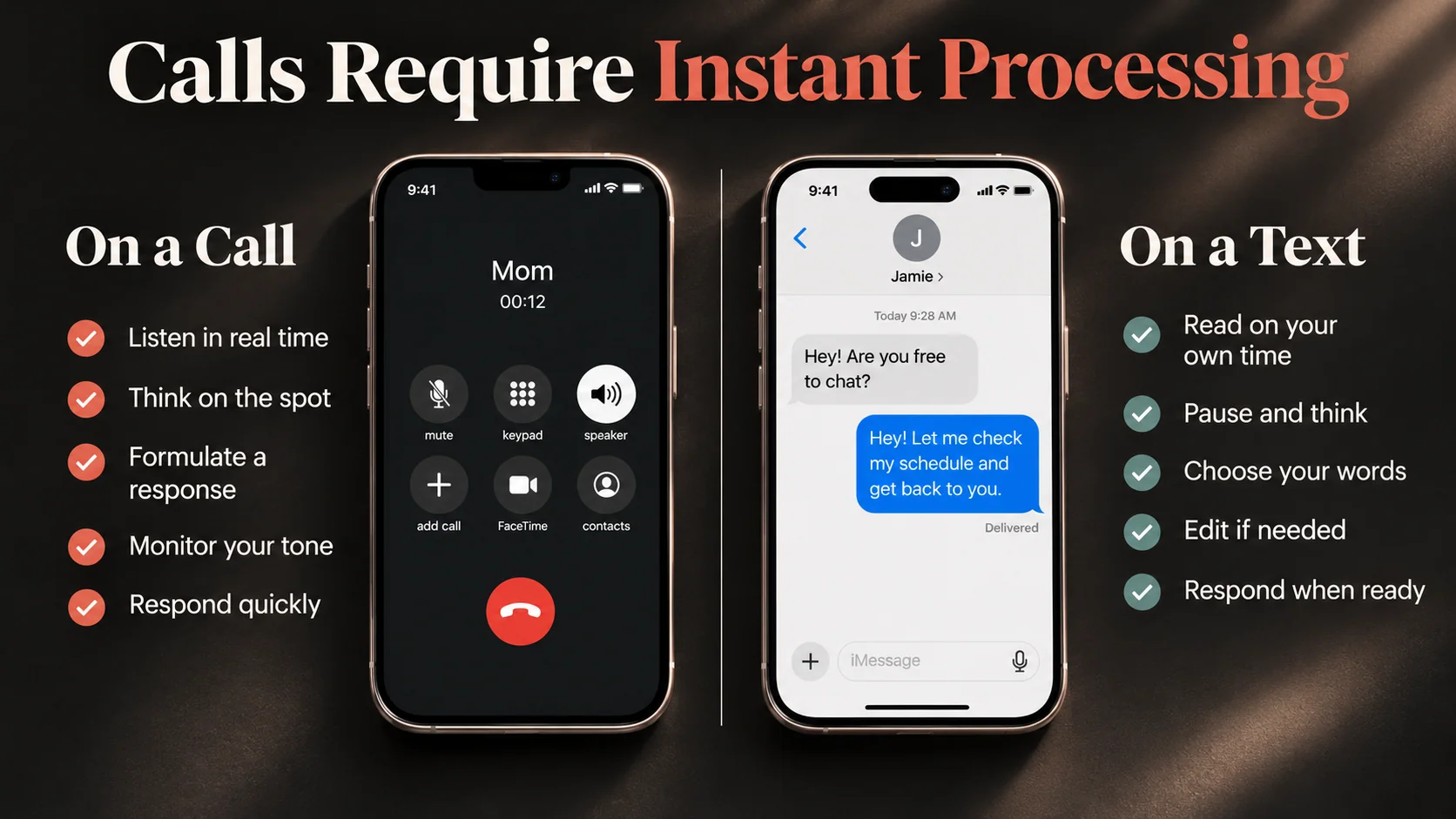
What this infographic shows
Two smartphone screens compare a live phone call with a text conversation. Calling requires listening, thinking, managing tone and responding in real time, whereas text can be read, revised and answered later.
The call answer rate is answered calls divided by calls placed. The contact rate, for an outbound campaign, is usually the percentage of unique people successfully reached during a defined period. Agree on what counts as a successful contact before comparing results.
Contact rate = (unique contacts reached ÷ unique contacts attempted) × 100.
For example, if you try to reach 1,000 customers and have a genuine exchange with 350 of them, your contact rate is 35%. Calling the same person five times doesn't create five reached customers.
A third metric deserves attention: the qualified conversation rate. How many exchanges lead to a useful answer, a meeting, a payment arrangement, a resolved case or another agreed next step? A customer who answers on WhatsApp but not on the phone may still be fully reachable.
Seven ways to improve customer contact rates
1. Start with clean data and an expected contact
A mistyped number, a duplicate record or a lead who no longer remembers the original request can undermine a campaign before the first call begins.
Validate numbers when they are collected. Keep the source and time of each request, communication preferences and relevant permissions. If someone has requested a callback, tell them which request you're following up on. A recognizable, expected contact has a better starting point than an anonymous interruption.
2. Make the caller identifiable and protect number reputation
Customers need a reason to trust what appears on their screen. Use consistent numbers, caller identification where supported, and processes to monitor spam labels and complaints. If a campaign triggers repeated reports, fix the cause instead of hiding behind a new number.
Rotating caller IDs simply to evade call filters is not a trust-building strategy. Being recognizable matters more than slipping past a filter.
3. Respond promptly, but don't mistake speed for pressure
A customer who has just filled in a form is generally easier to engage than someone who receives a callback long after their request. Yet a fast response doesn't have to mean an immediate unsolicited call.
A brief confirmation message can offer a choice: get the answer here or select a convenient call time. Your team responds quickly; the customer keeps control of when the conversation happens.
4. Match the channel to the market and the relationship
WhatsApp matters enormously in some regions and much less in others. In Twilio's Communications Blueprint, WhatsApp appears among the three preferred channels for business communications for 84% of respondents in Latin America, 63% in EMEA, 62% in Asia-Pacific and 14% in North America.
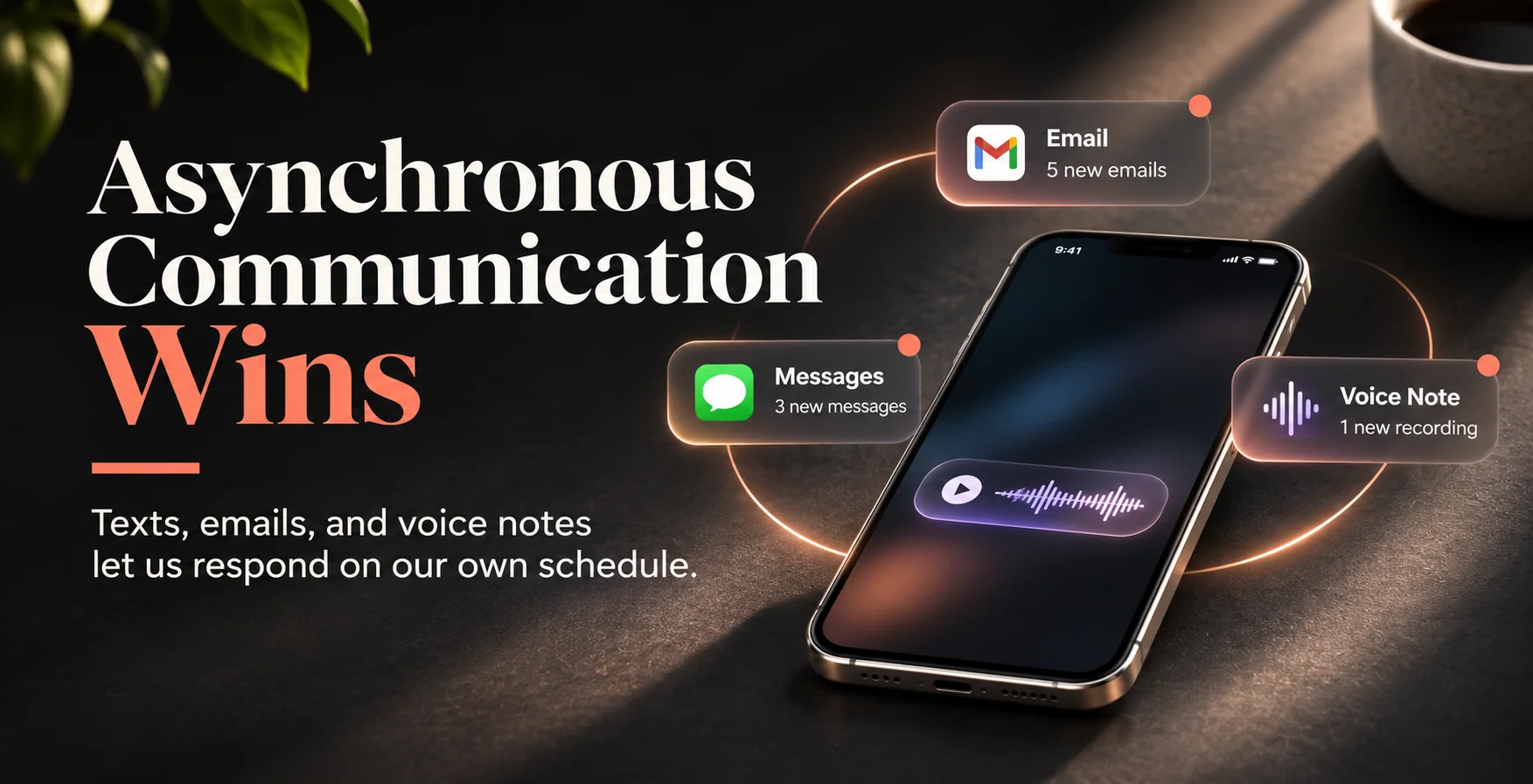
What this infographic shows
A phone with a voice note, surrounded by notifications for text messages, email and audio. The contrast is between messages that people can handle on their own schedule and phone calls that demand immediate attention.
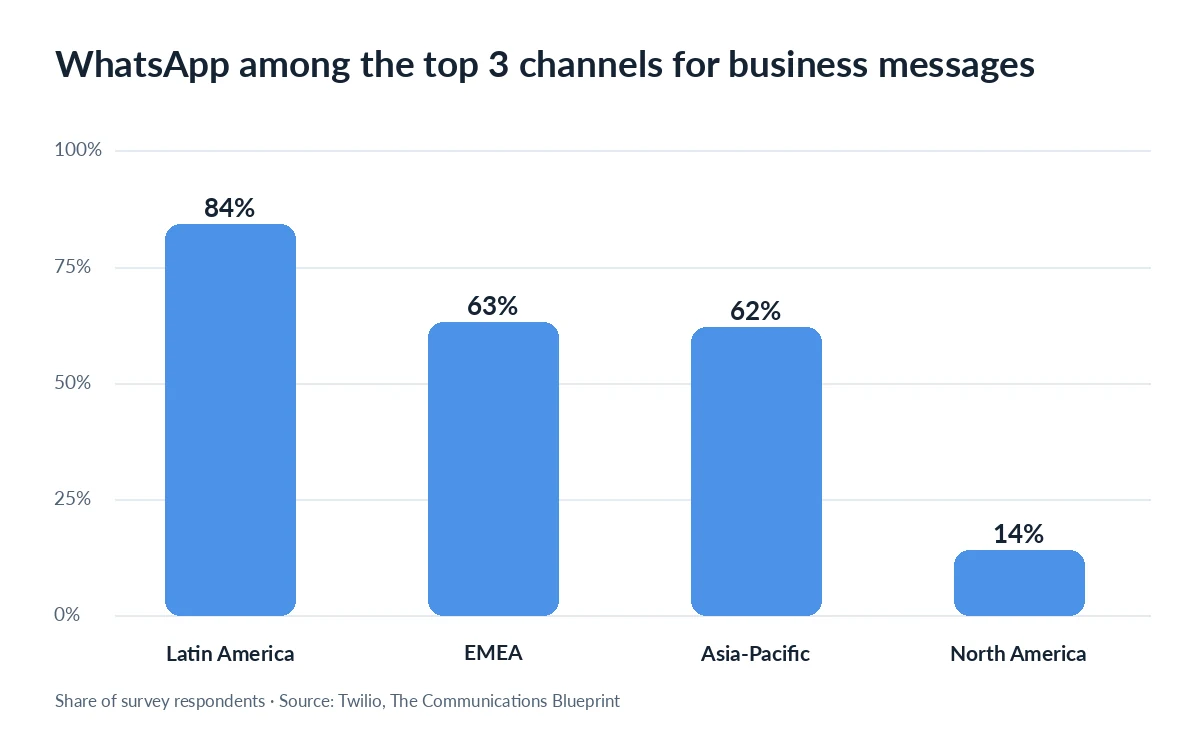
In Latin America, a WhatsApp message may be the natural way to continue an existing customer relationship. In North America, SMS or email may be a better first step. For B2B prospecting, email or LinkedIn can be more appropriate until a relationship and permission to message exist.
The best channel is the one your customer uses and has agreed to use with you.
5. Give customers a reason to reply before asking them to answer a call
A first message should answer three questions: who is contacting me, why, and what can I do next? A generic “Hello, are you available?” gives very little away and can feel like mass prospecting.
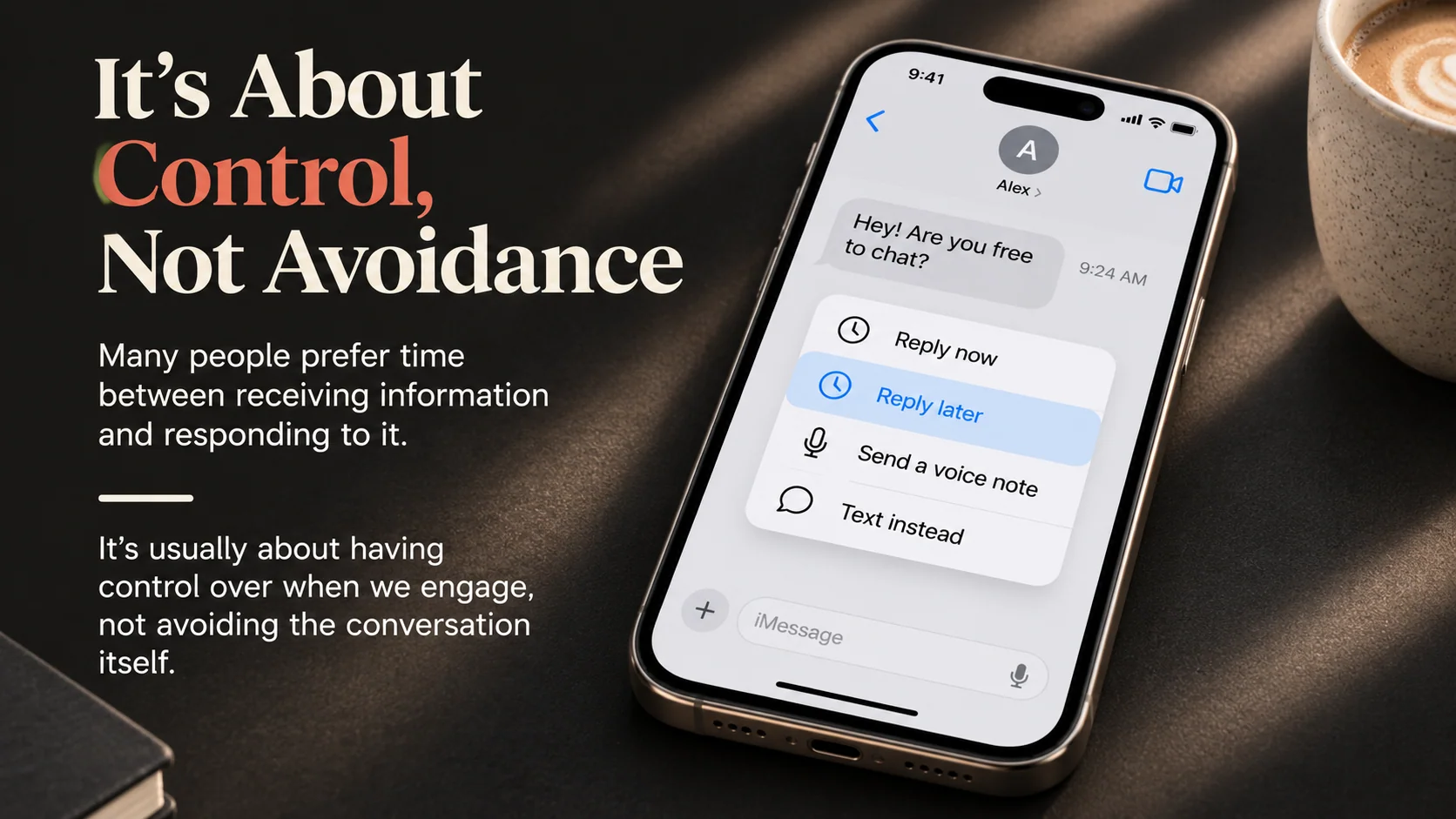
What this infographic shows
A text message on a smartphone offers options to reply now, reply later, send a voice note or text instead. The visual argues for giving customers control over when and how they respond.
For example, after someone requests a quote and agrees to be contacted through WhatsApp:
Hi, you requested an estimate on our website. I can send you the first details here, or we can arrange a quick call. Which would you prefer?
The message should begin a real exchange, not serve as an excuse to call thirty seconds later.
6. Offer a voice note when it's easier than typing
Text works well for many requests. But describing a technical issue, explaining a situation or adding detail can be easier by voice. A voice note lets customers speak without committing to a live call.
With the right configuration and permissions, AI can transcribe the note, identify the request and prepare an answer or action. A human agent can then pick up the exchange without asking the customer to start again.
Not everyone likes voice notes, especially unsolicited ones. Make them an option, not a compulsory step.
7. Call when a live conversation adds value
Some situations are easier to resolve together: a delicate service issue, a negotiation, a complex sale or a sensitive collections discussion. A call still matters. It simply works better when both sides know why it is happening.
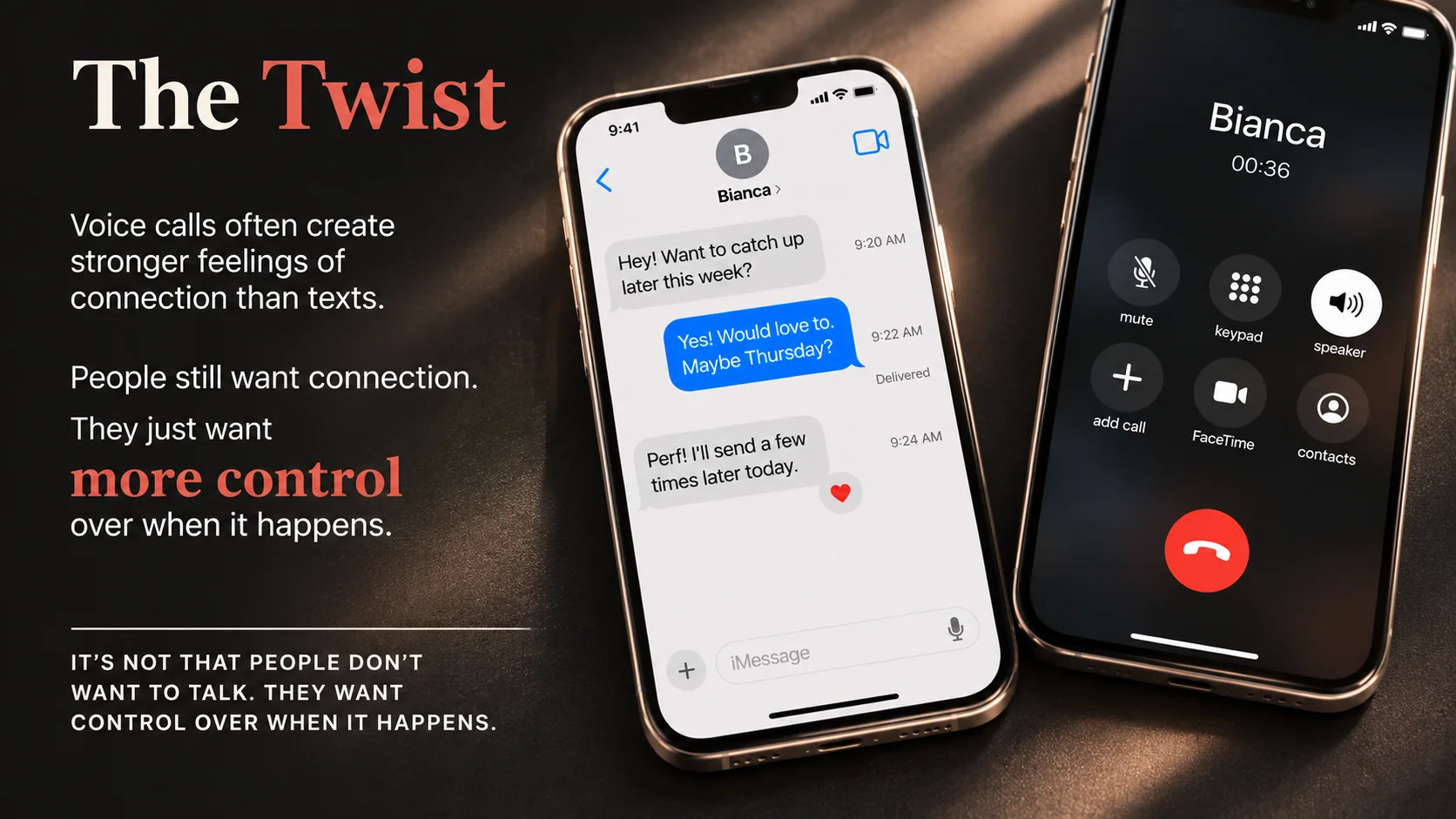
What this infographic shows
A WhatsApp-style or text conversation progresses to a live voice call with Bianca. It illustrates that people still want connection, but often prefer to choose when a call takes place.
The customer has already explained the issue or selected a call time. The agent has the text and voice-note history, provided the contact center integration supports it. The call becomes the next part of a conversation—not the first surprise.
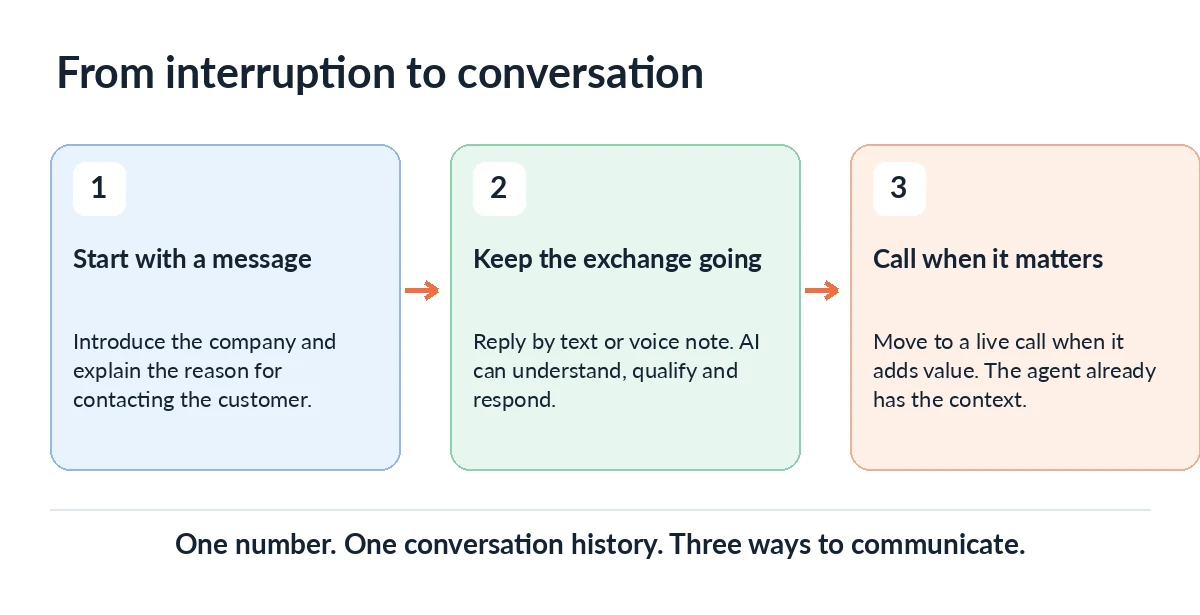
WhatsApp, AI Workforce and Valoria: one joined-up approach
Consider a quote request. A customer agrees to receive a WhatsApp message. The business confirms the request. The customer replies with two questions and sends a voice note to clarify their needs. An AI agent handles the information available and suggests an answer. A point still needs discussion, so the customer chooses a call. The human agent starts with the context already in hand.
This continuity can improve the experience and reduce unnecessary repetition. It does not guarantee a higher answer rate in every market or industry. The result has to be tested.
For Vocalcom, each component has a clear job: WhatsApp starts the conversation. AI Workforce qualifies requests, takes action and resolves what it can. Valoria helps optimize calls when they are needed.
The approach applies to sales, service and collections, although the permissions, processes and outcomes differ. The focus shifts from “How many calls did we place?” to “How many useful conversations did we move forward?”
How do you measure whether a message-first strategy works?
Compare two journeys using comparable, properly consented groups: direct calling and a message-first approach with calls offered when useful. Use the same measurement period for both.
Track:
- Phone contact rate: the share of unique people who actually answer and engage by phone.
- Message reply rate: a genuine reply, not merely delivery or a read receipt.
- Qualified or resolved conversations: exchanges that produce a clear next step or outcome.
- Cost per useful result: cost per meeting, sale, resolved issue or completed arrangement.
- Negative signals: opt-outs, blocks, complaints and requests to stop contact.
A higher pickup rate is not always the best outcome. The stronger strategy is the one that produces more value without wasting customers' time or your team's capacity.
Can a business message someone on WhatsApp before calling?
Yes, where it has the necessary permissions and follows the applicable rules. WhatsApp's Business Messaging Policy sets requirements for contacting people, opt-in, approved message templates and stopping messages when requested.
Local law matters too. As one example, France introduced tighter rules for consumer telemarketing from 11 August 2026, with defined exceptions. The French data protection authority (CNIL) explains those rules. Other countries have different requirements. Always check the rules of the market in which you operate; WhatsApp is not a workaround for unsolicited prospecting restrictions.
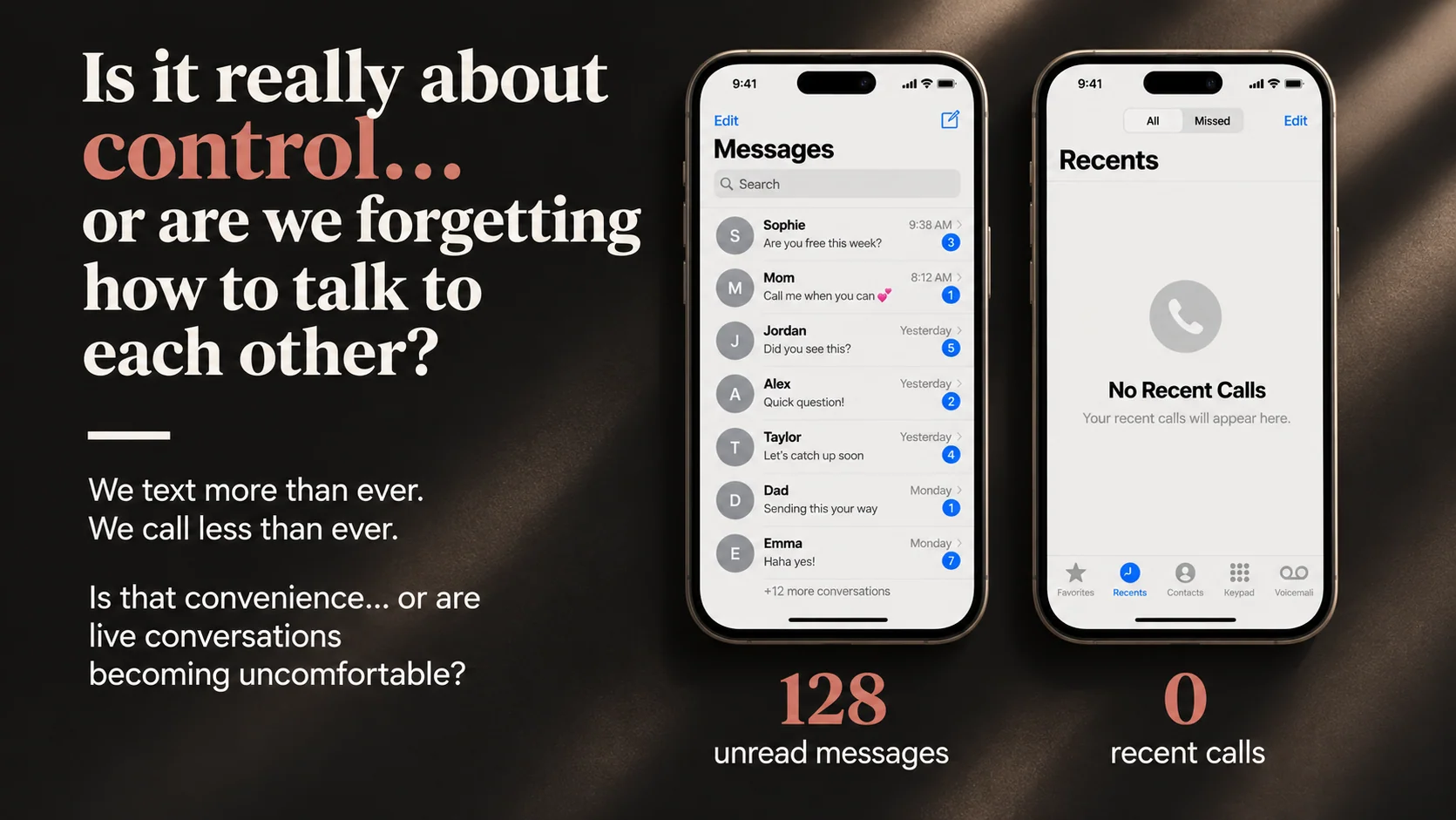
What this infographic shows
Two phones contrast an active message inbox with an empty recent-calls list. The numbers 128 unread messages and 0 recent calls are illustrative interface examples, not survey statistics. The visual asks whether fewer calls reflect convenience or discomfort with live conversation.
The better way to improve contact rates
For years, outbound teams were measured by calls placed, retry rates and talk time. Those metrics still have a place, but they don't tell the whole story.
A better question is whether the customer recognizes the business, understands why it is reaching out and has a convenient way to respond. If a call is needed, does it arrive at the right moment with the right context?
Text first. Voice note when it helps. Call when they're ready.
Earn the call.
Frequently asked questions
What is a customer contact rate?
The percentage of unique contacts a business successfully reaches during a defined campaign or period. Specify whether a contact means a phone conversation or a meaningful response on any channel.
How do you calculate an outbound contact rate?
Divide the number of unique contacts reached by the number of unique contacts attempted, then multiply by 100. Reaching 350 out of 1,000 contacts gives a 35% contact rate.
How is contact rate different from call answer rate?
Call answer rate counts answered calls against calls placed. Contact rate counts people reached against people attempted. Multiple calls to the same person can therefore produce very different figures.
Does WhatsApp improve customer contact rates?
It can give customers a convenient asynchronous way to reply, particularly where WhatsApp is widely used. But channel-preference surveys do not prove a specific lift in pickup rates. Test qualified replies and conversions against a comparable calling-only journey.
Should we send a message before every outbound call?
No. A requested immediate callback, an urgent situation or an established working relationship may call for direct phone contact. Use message-first when it adds context and choice—and when permission allows it.
What helps improve B2B contact rates?
Accurate records, relevant outreach, recognizable caller IDs and an appropriate mix of email, telephone and messaging. Offer scheduling when useful and measure qualified conversations rather than dialing volume.
Sources and methodology
- Hiya — State of the Call 2026, survey across six countries; analysis of unknown-number answering behavior.
- Hiya — March 2026 announcement, unwanted-call frequency.
- Kantar / Meta — State of Business Messaging, 11,056 adults in 22 markets; research conducted in 2025 and published in 2026.
- Twilio — The Communications Blueprint, regional channel preferences.
- WhatsApp Business Messaging Policy and CNIL — French telemarketing rules, compliance context.
The figures are consumer-survey findings and published source data. They are not guaranteed contact, conversion or reply rates for any business.