Being reachable
Reputation monitored. Automatic rotation. Geo-local numbers where allowed. Volume cap per line.
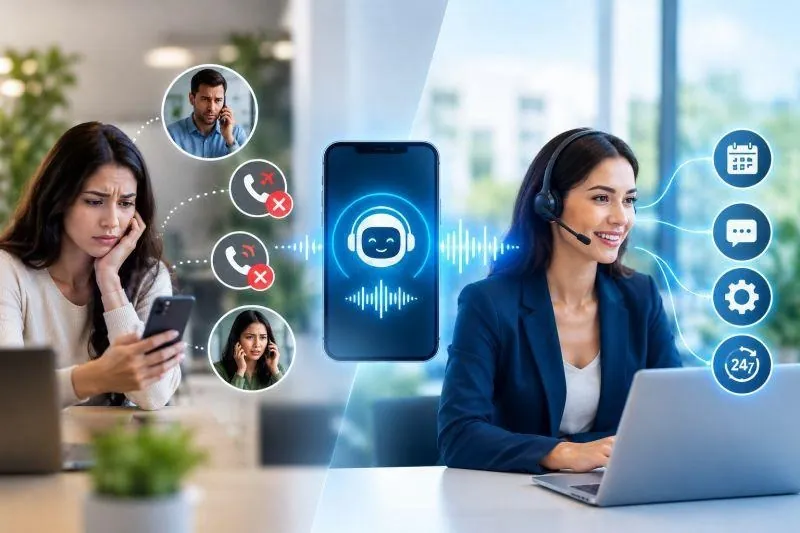
Burned number. Wrong moment. A call that never even rang on their phone. Three ways to lose a lead you already paid for. Valoria fixes them, one by one, before the lead goes cold.
The real cost
Nobody tracks the distance between a lead and an agent’s voice. A good lead, a burned number, bad timing, a call that never rings — different causes, same outcome: no conversation. Vocalcom gets your reps on the phone with the lead in under 2 minutes.
?
→
Four levers
Reputation monitored. Automatic rotation. Geo-local numbers where allowed. Volume cap per line.
A carrier rejection isn't a refusal. A voicemail isn't a customer. Valoria tells them apart.
The lead goes out the moment an agent is free. The callback keeps the same number. The text message warns ahead of time.
Call, text, and WhatsApp where the customer already is. One thread, orchestrated.

Lever 1
Two watch systems, running continuously. Anti-spam apps first — about ten sources, checked every hour. The carrier next: past two hundred calls a day on the same line, it gets flagged.
The moment a reputation drops, the number rotates. Nobody has to watch a dashboard. The line leaves the pool before it burns out, not after.
Where it's allowed — leads, collections, fundraising — geo-local numbers switch on by themselves.
Lever 2
The most invisible part of a calling operation. And the most expensive.
Lever 3 · Ding-dong
The smoothed-out flow — everyone knows it. A theoretical volume, spread across the day, with no connection to what's actually happening on the floor. Result: leads in bursts when everyone's already on a call, and nothing when agents are sitting idle.
Ding-dong flips this around. A webhook exposes your agents' real availability to your lead providers. Hot lead, immediate call. While it's still hot.
Appointment booked? The callback goes out from the same number the customer already knows. A text warns ten minutes ahead. That text alone is worth eight points of reach rate.
Lever 4
For customers who said yes to a WhatsApp call, the reach rate borders on 100%. Makes sense: they agreed to be called there, and they recognize your verified account. This isn't a mass channel. It's the one for the people you'd otherwise stopped reaching.
New
An unknown number gets ignored. Normal reflex: spam, fraud, nobody wants to risk it. Branded Call breaks that reflex. Your company name shows up on the recipient's screen, even if the number isn't in their contacts.
They decide knowing who's calling. Not ignoring a stranger on principle. One more trust signal, alongside number rotation and verified WhatsApp calls.
Available today, on Valoria.

After the call
An uncomfortable number: a good chunk of what an agent writes down after a call is wrong. From memory, between two calls, at the end of the day. Those errors contaminate everything downstream — follow-up, management, decisions.
Valoria transcribes, qualifies, summarizes. Points covered, commitments made, next step. The agent reviews it, confirms it. Two minutes of after-call work become fifteen seconds. And your data becomes true again.
What the research shows
Nothing intuitive about this. Fifteen years of research on hot-lead management, hundreds of thousands of calls analyzed. One message: what decides conversion plays out in the minutes that follow. The exact multipliers vary by study — from several times over to more than a hundredfold, depending on the method. The direction never varies. Every minute of delay costs you.
Past that window, interest drops off. The prospect has already moved on elsewhere.
At Valoria — ding-dong delivers the lead the moment an agent is free. Not on some theoretical schedule.For an active buyer, an answered call converts better than a message sent faster.
At Valoria — the call remains the primary channel. Text and WhatsApp follow up, they don't replace it.The first free agent isn't always the right pick. Real availability is.
At Valoria — ding-dong exposes that availability to your lead providers, live.A single attempt is almost never enough. Combining channels recovers what one alone would have lost.
At Valoria — call, text, WhatsApp chain together attempt by attempt. No manual work.An agent who already knows what the prospect asked for converts better than one discovering it live.
This principle depends on your upstream data — the form, the CRM. Valoria qualifies the exchange after the fact. The starting context stays yours.Indicative sources: the Lead Response Management Study (Oldroyd, Kellogg/MIT, via InsideSales.com) and later work on Harvard Business Review data. The figures vary by study. We treat them as an order of magnitude, not a Vocalcom measurement.
Simulator
Your numbers. Our assumption — 20% more conversations — adjustable. Instant calculation, no sign-up.
Assuming the conversion rate on conversations stays constant. Valoria increases the number of conversations, not the agent's closing skill. Your lead budget doesn't change; its yield does. In the demo, we recalculate on your real file.
The gains, lever by lever
| Mechanism | Effect | What it affects |
|---|---|---|
| Automatic rotation on damaged reputation | +15 % | Reach rate — protected lines, never blocked |
| Geo-local numbers, where authorized | +11 % | Reach rate, on top of rotation |
| Heads-up text before a scheduled callback | +8 % | Reach rate on scheduled phone appointments |
| Retrying carrier rejections | 6–8 % | Share of affected calls — currently counted as lost |
| AI voicemail detection | 97 % | Reliability, in under a second, telling refusal apart from no-answer |
| Automatic call summary | 2 min → 15 s | After-call work, and reliable data into the CRM |
Frequently asked questions
Valoria is native on Vocalcom. On a third-party platform, integration runs through an API, and depends on what that platform exposes — especially around numbering. We'll tell you plainly, before any commitment, what works for you and what doesn't.
No. That's why the platform activates them by use case and by country. Some markets restrict their use depending on the nature of the call. The configuration follows the local rule. It doesn't work around it.
Two paths. A notification asking for permission. Or a text inviting them to write in — the customer writes, the conversation opens, the call becomes possible with their consent. Meta's limits on outbound calls are managed by the platform.
A two-way webhook: your provider either receives an availability signal, or queries the platform before sending. The implementation is light. But it exists — it's the one thing to plan for on the partner's side.
That's exactly what the refusal/no-answer distinction prevents. 97% reliability, in under a second. The remainder exists, and the configuration lets you choose the behavior when in doubt — it's not for us to decide on your behalf.
Three numbers, before and after, on your own base: reach rate, share of attempts that actually landed, time between lead receipt and first contact. We measure them together, in the demo, on a sample of your file.
You just estimated your numbers with the simulator. In the demo, we recalculate them on your real file — leads, reach rate, conversion. And we show you exactly where today's attempts are going that shouldn't be.